
I’ll have to write a bit more later on the “how” of it, but for now, just a quick “first light” of barney rendering the latest “Drosophilia Brain” data set (using four H100 GPUs).
That “droso” data set is from the “Virtual Fly Brain” project https://www.virtualflybrain.org/, and was recently used by/featured in multiple major articles (e.g., this one: https://www.nature.com/articles/d41586-024-03190-y)… and the best thing about this is that one can actually download the full neuron connectome data (in SWC format). Now I’m sure they’re primarily sharing that data for purposes other than just rendering – but this is still a very nice “hero” data set for testing a (GPU!-)ray tracer with: The full droso has 140,000 neurons (the image on the nature page shows only the 50 largest), and though that doesn’t sound all that much, it actually is: each individual neuron can consist of “multiple” (ie, a lot) of different “segments”… so the total data is – if I can trust to the importer code I wrote – a total of 727 million such segments. The input SWC files alone are 34 GBs, and with additional data for colors, acceleration structure, etc, this is far more than can be fit on a single GPU.
Barney already had a “capsules” geometry that can handle this kind of “link” data, and since the capsules are relatively easy to distribute across multiple GPUs (barney doesn’t care how they get distributed, so I literally assign them in file order)…. so other than data wrangling this pretty much worked out of the box. The full thing – with over 700 million links – needs more than one GPU, but it does (just barely) fit into a machine with four H100s.
And thus: ta-daa – here’s the first few images…
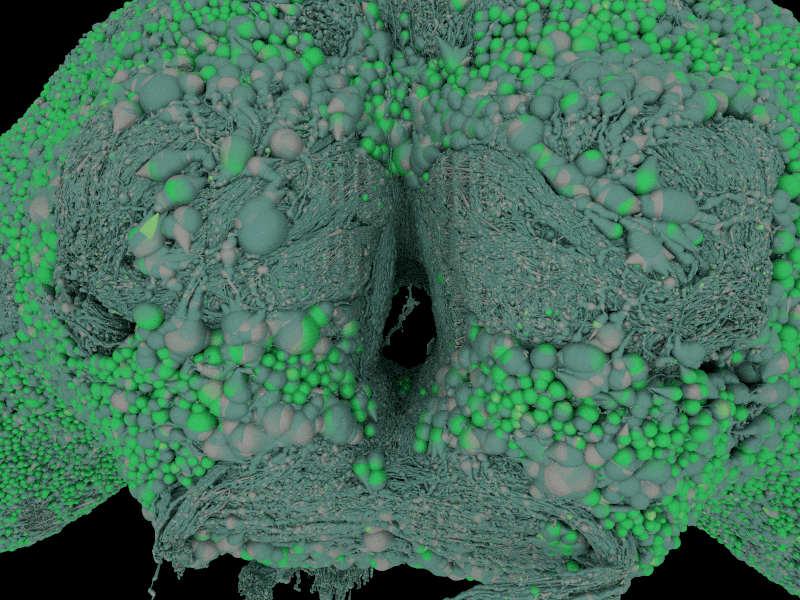

And while the image on the nature page (https://www.nature.com/articles/d41586-024-03190-y) shows “the 50 largest” of the neurons … this is all 140,000 of them :-).
PS: before I forget – Big kudo’s to Stefan Zellmann (University of Cologne), Serkan Dmirci (Bilkent University), Alper Sahistan (Univ of Utah), and Milan Jaros (it4innovation Institute, Ostrava), who were the ones that did these two specific images – I did the original data wrangling, and getting barney to be able to render that …. but the actual rendering, choice of colors, lights, camera, depth of field, and hardware wrangling – that’s all theirs!
PPS: Yes, barney is a interactive renderer, so in theory this data can be rendered interactively. But this particular machine didn’t have any X server, so this was rendered directly to file.
 Ingo's Blog